VARIOUS AFRICAN TAXA
Alvesia rosmarinifolia (Lamiaceae)
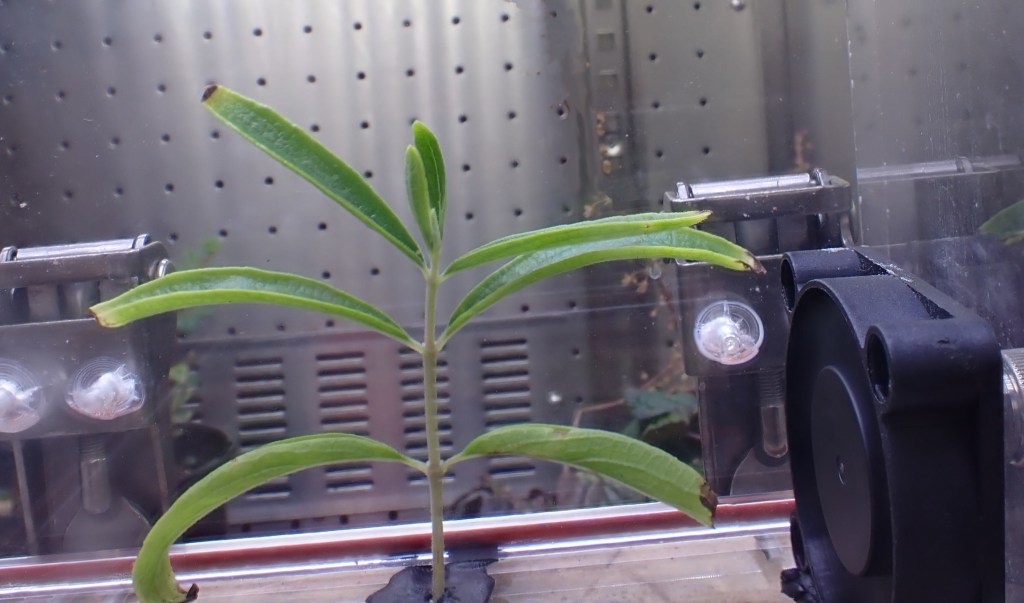
I selected this species as a C3-control for gas-exchange of taxa within the Lamiales (see figure below) because its specific epithet is similar to the name of my spouse. Native to Angola, Congo, Gabon, Zaire and Zambia, A. rosmarinifolia is a sub-shrub or shrub that grows primarily in the seasonally-dry tropical biome.
I had only one plant.
The CO2-exchange pattern was not a typical C3 one. Under well-watered conditions respiratory CO2 loss in the dark appeared low and was not constant from night to night.
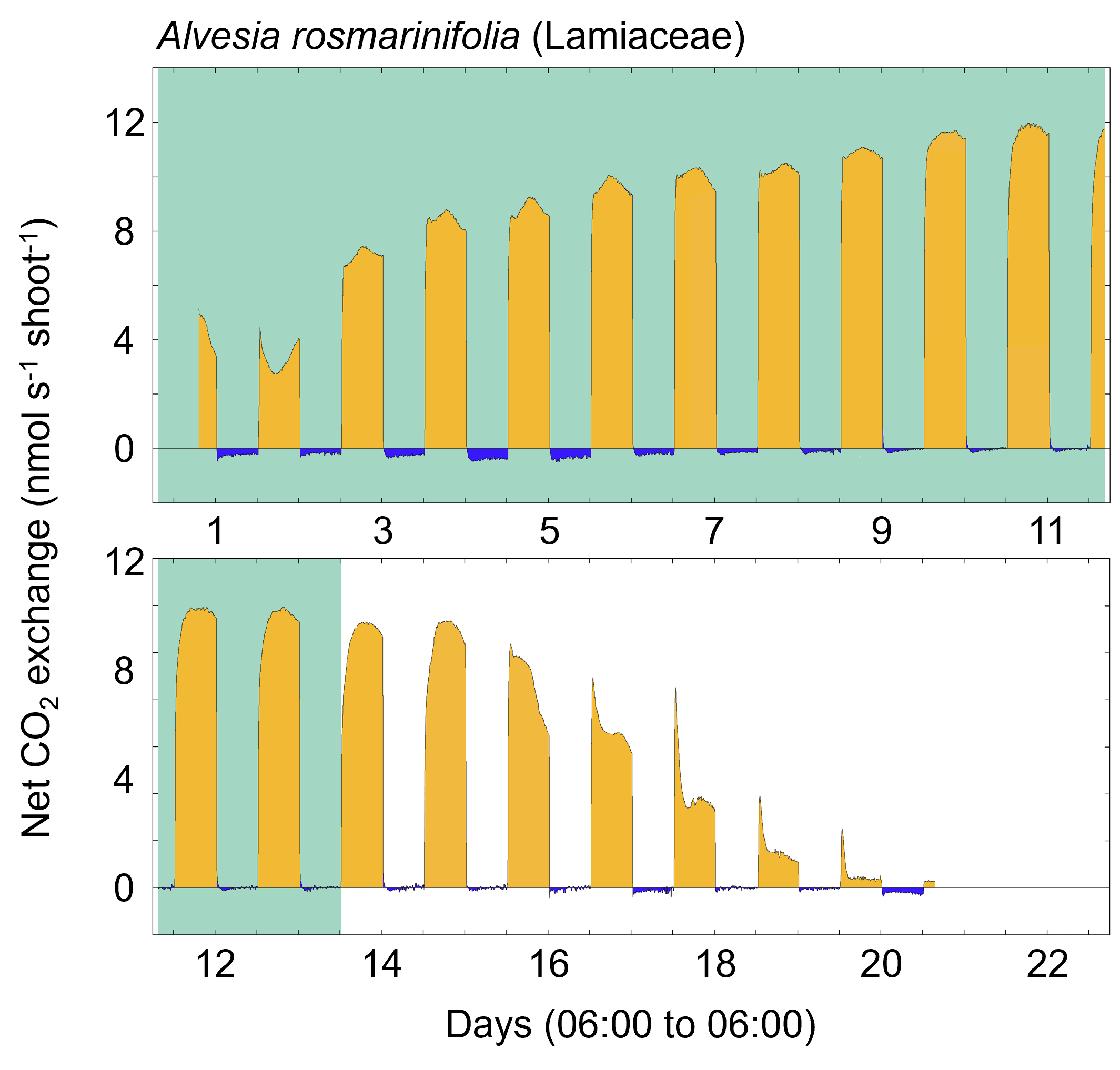
Green background indicates well-watered, white background denotes no watering. Leaf CO2 exchange during the light is shown in gold, CO2 exchange at night in blue. Pot was 11 cm in diameter. The intact shoot was enclosed in a 15 cm x 15 cm x 15 cm Perspex chamber supplied with 2 L min-1 of air. 12 h day/12 h night temperatures were 26 and 20 oC respectively. Day and night dew points were 18 oC.
The signal was more akin to a cryptic CAM species in which the CAM signal was strengthening slightly. Under well-watered conditions, low levels of net CO2 uptake occasionally occurred towards the end of the night. The pattern was similar when the plant was subjected to water-deficit stress.
Unfortunately, the plant died during the water deficit phase before I could re-water it. I stressed it a day too long. It was a small plant with 6-8 leaves.
I am unable to purchase more seed until 2024 and will have to wait until winter for germination and to grow-on plants. I will need considerable biomass to measure leaf acid contents as the gas-exchange data indicates that acid pool sizes will be low. I will also need an appropriate number of replicates.
If Alvesia does perform CAM it will be the first of the three Alvesia Welw. taxa known with CAM. There are other CAM-containing genera in the Lamiaceae, including Coleus Lour. and Plectranthus L’Hér.
CAM in Cyphostemma
Although all 240 Cyphostemma, including herb, caudiform and tree-like clades, are assumed CAM by Gilman et al (2023), nocturnal malate accumulation typical of CAM has been reported only in C. juttae (Dinter & Gilg) Desc., C. currorii (Hook. f.) Desc. and C. bainesii (Hook.f.) Desc. (Virzo de Santo et al., 1981). Together with C. quinatum, these caudiciform species are all in one southern African clade. Mooney et al. (1977) reported CAM-type carbon isotope values of -12.2 ‰ for C. currorii at Hochland Pass (S.W. Africa) and -14.8 ‰ for C. quinatum at Grahamstown, Plutos Vale (Fish River Karroid scrub).
I obtained seed of Cyphostemma quinatum (Dryand.) Desc. ex Wild & R.B.Drumm (Vitaceae) which I have been able to germinate and grow-on. Native to South Africa (Cape Provinces, KwaZulu-Natal) and Mozambique, C. quinatum is a climbing sub-shrub or shrub within the sub-tropical biome. It has a caudiform succulent stem and thickish leaves that it sheds in the dry winter season.
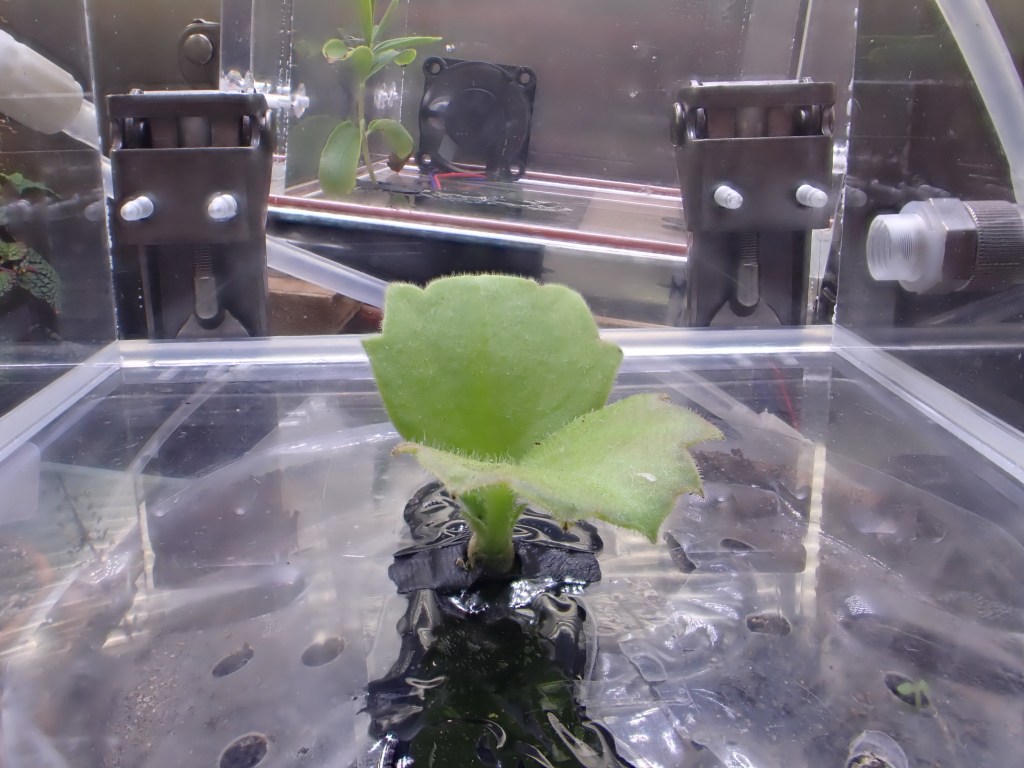
The gas-exchange I have performed to date is shown in the figure below. Takes a while for the afternoon peak to return following rewatering.
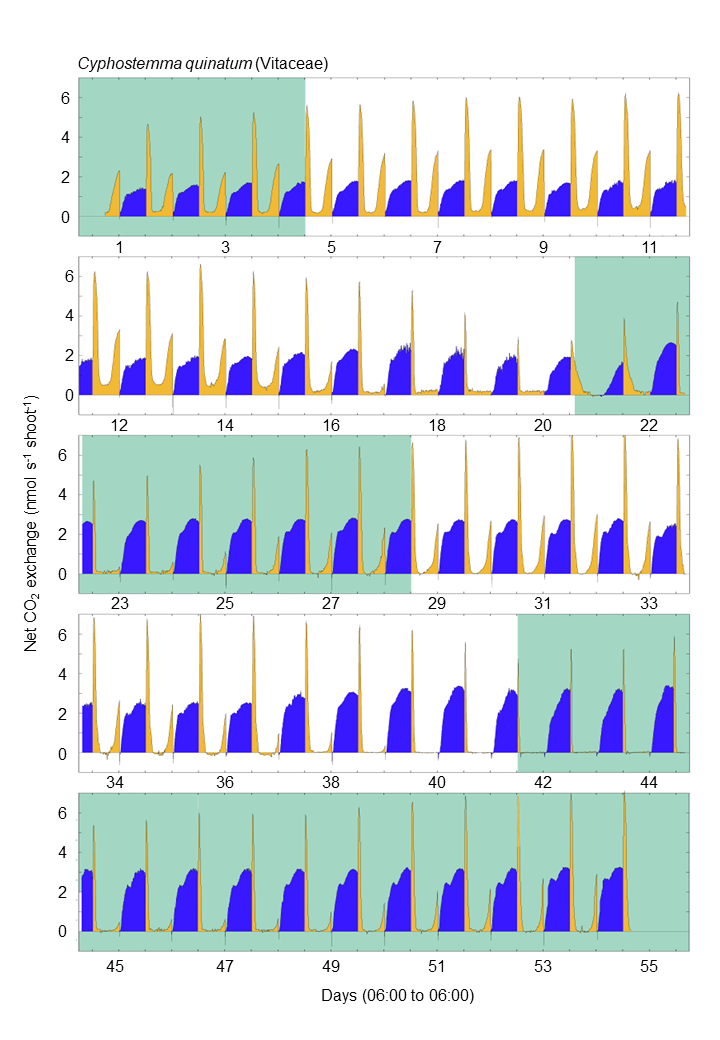
Green background indicates well-watered, white background denotes no watering. Leaf CO2 exchange during the light is shown in gold, CO2 exchange at night in blue. Pot was 11 cm in diameter. The intact shoot was enclosed in a 15 cm x 15 cm x 15 cm Perspex chamber supplied with 2 L min-1 of air. 12 h day/12 h night temperatures were 26 and 20 oC respectively. Day and night dew points were 18 oC.
Now to try and get seeds so that I can perform gas-ex on exemplars from the other Cyphostemma clades!
 Joe Holtum's Science Site