THE HOYA PROJECT
Participants: Michele Rhodda (Singapore Bot. Gdns.), Klaus Winter (STRI), Joe Holtum (JCU)
Project: To explore the expression of CAM photosynthesis in Hoya R.Br. (fam. Apocynaceae), a genus of 500+ species, mostly epiphytic climbers. A few species are associated with ants.

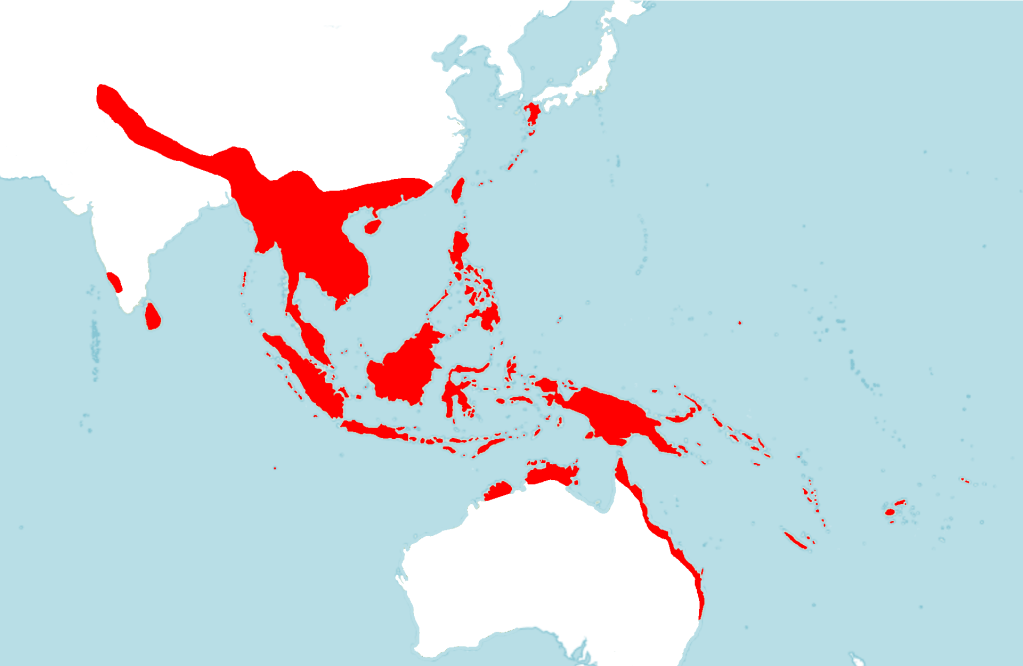
Distributed between the Himalayas and Australia, Hoya is most speciose in the humid tropics of south-east Asia, Philippines and the Indo-Australian Archipelago (see map below). They also inhabit areas with pronounced seasonality (e.g. southern and south-east Asia), including tropical, sub-tropical and warm-temperate montane areas.
Both Hoya and Dischidia, a closely related and generally morphologically similar genus of ca. 130 species, often have thick leaves. Water-conserving CAM photosynthesis has been documented in a handful of species from each genus.
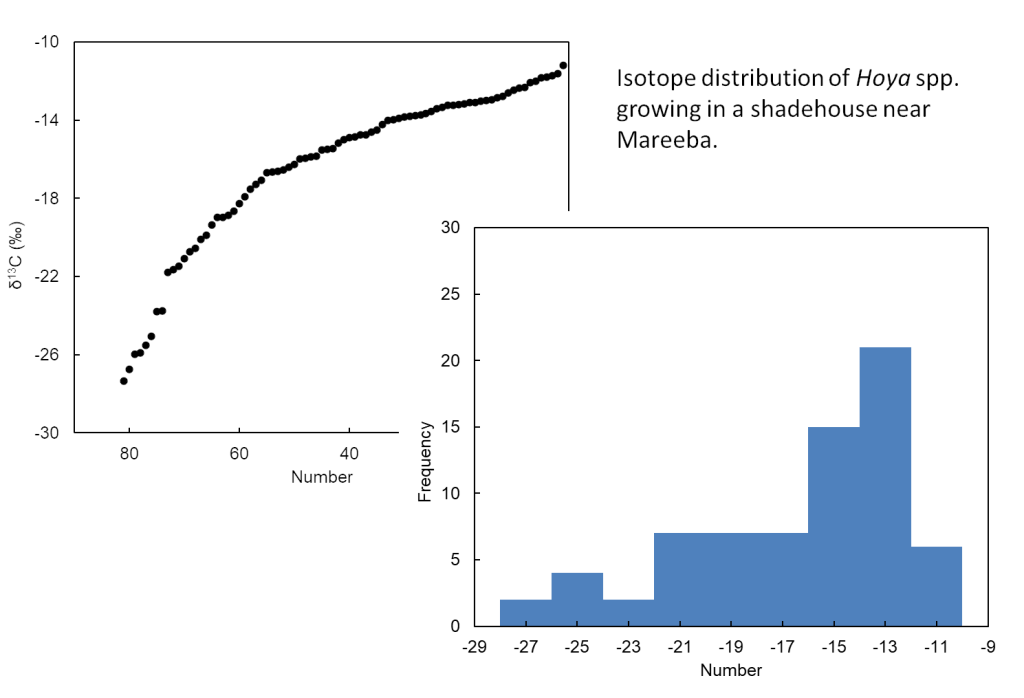
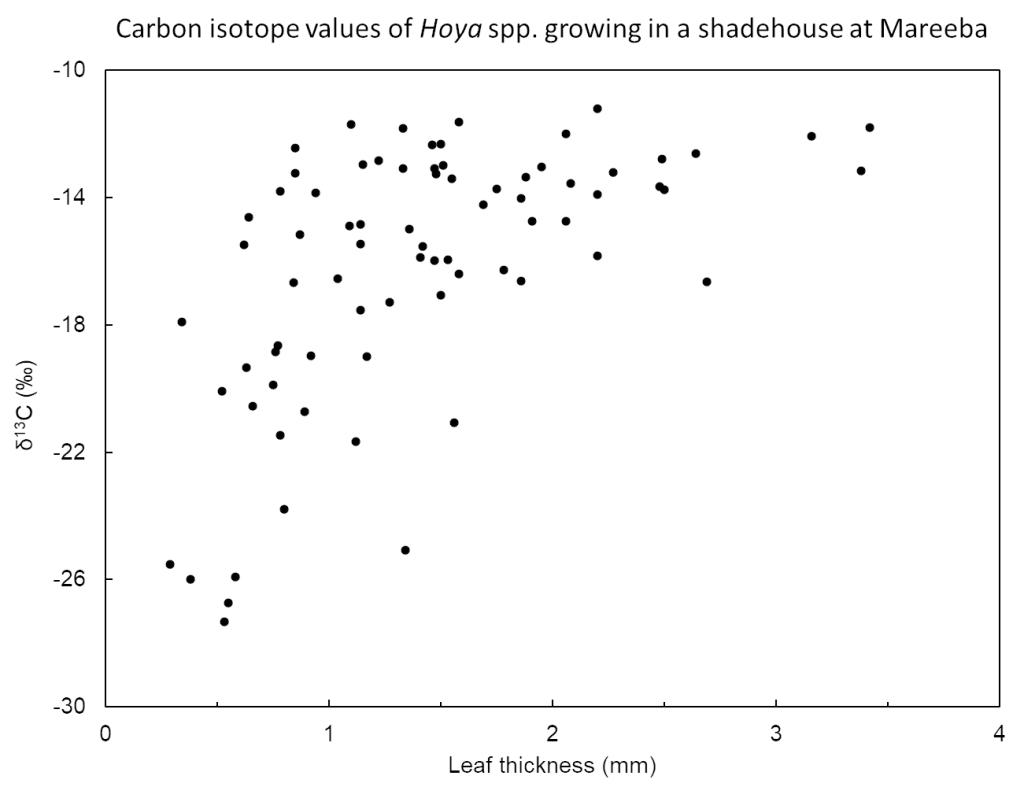
Progress: We have measured the carbon isotope ratio (δ13C) and leaf thickness from over 100 species growing in two environments and have have measured nocturnal changes of leaf titratable acidity in many. Continuous gas-exchange has been measured for some Australian species over cycles of watering, withholding water and rewatering. In general, although the δ13C values range between -11 ‰, what one would expect for plants that obtain CO2 solely during the night, and -33 ‰, what plants that obtain CO2 solely during the day, we have yet to identify a species that does not express nocturnal leaf acidification, a defining characteristic of CAM photosynthesis.
Fewer Dischidia have been studied but, to date, the observations are similar to those for Hoya.
 Joe Holtum's Science Site