THE GREAT BASALT WALL: A REMARKABLE LANDSCAPE MOSAIC VISIBLE FROM SPACE
I have been involved in two projects on the Great Basalt Wall.
The Great Basalt Wall is a 120 km-long igneous formation 42 km NW from Charters Towers and 180 km SW of Townsville. The name reflects the abrupt transition the margins of the basalt which emerge above the surrounding seasonally-dry woodland savanna.
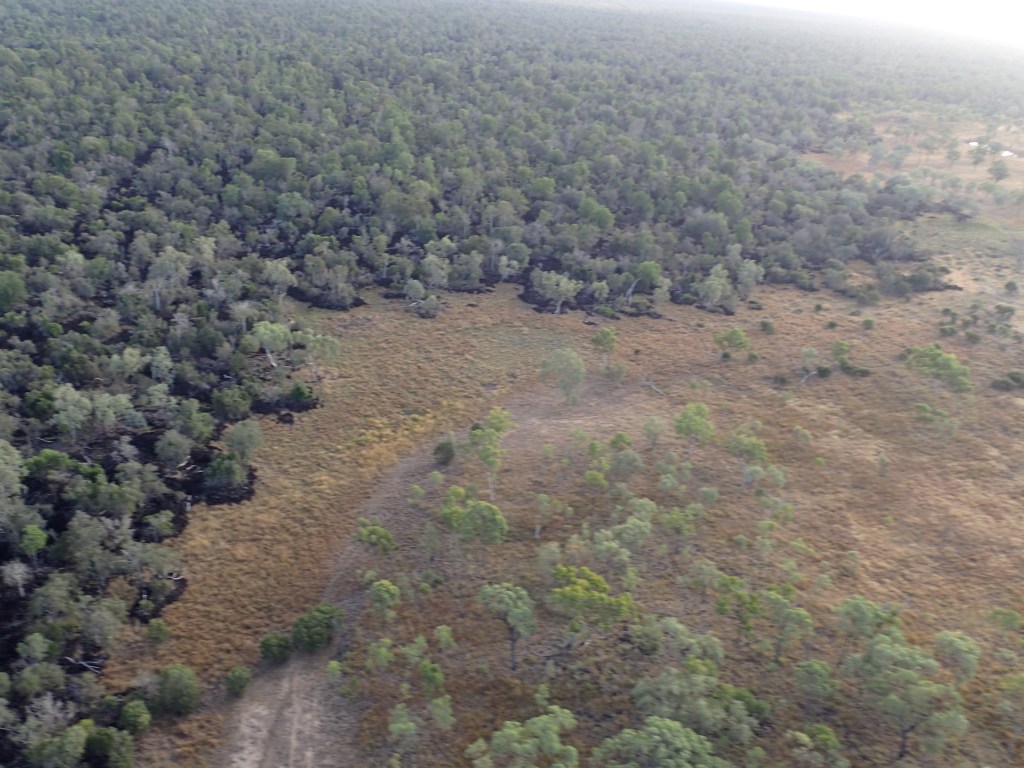
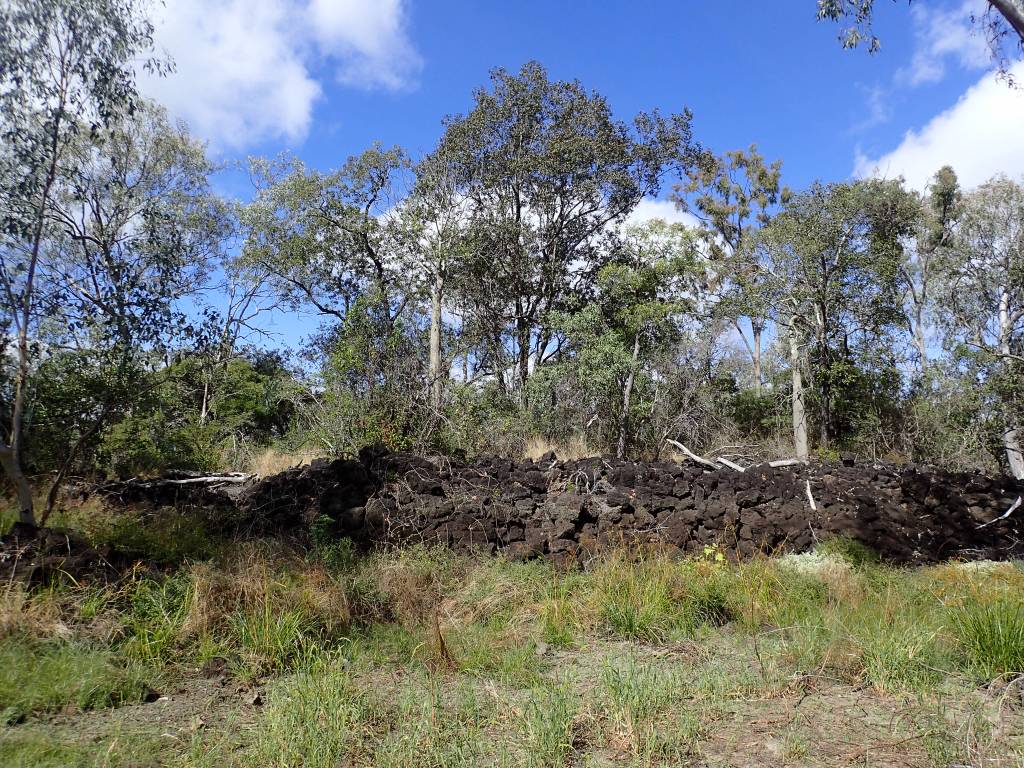
The wall is part of the Toomba flow, the youngest section of the Nulla Volcanic Province (3, 4, 5). At the western end of the flow, the small volcano that erupted ca. 20,815–19,726 BP (2) during the last glacial maximum is now a conical hill 4 to 5 km across and 100 m high (5). The eruption was probably the most recent major volcanic activity in north-eastern Australia. The west to east orientation of the lava flow reflects eastward slope of the terrain (only 0.2o).
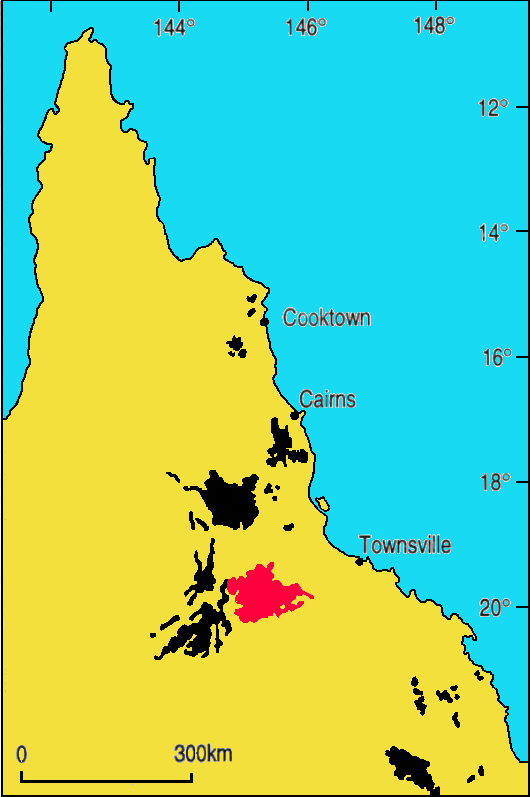
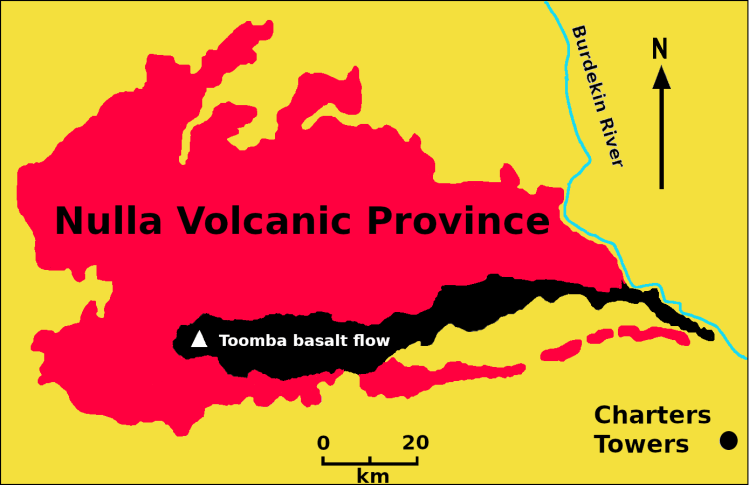
Flowing along low-points of the terrain, principally creeks and gullies, the lava occasionally encircled sachets of land creating vegetated ‘pockets’ isolated from the surrounding savanna. The species lists (no invertebrates listed) below are from https://parks.des.qld.gov.au/parks/great-basalt-wall
Despite a wet-dry tropical climate and periodic intense rainfall, the rough surface of the basalt has weathered little and soil has not formed. The rugged sharp-edged surface, scree of gas-bubble pocked basalt boulders, sink-holes, uneven surfaces and lack of grass deter cattle. Many of the pockets are essentially ungrazed and contain few weeds. The whole area is dotted with perennial spring-fed, semi-permanent and seasonal wetlands.
The landscape mosaic is remarkable. In satellite photographs, the dark forested surface stands out from the surrounding ecosystems. The soil-free basalt is covered in vine-thicket, often dense, and includes emergents such as bottle-trees (Brachychiton spp), figs (Ficus spp), Burdekin plum (Pleiogynium timorense) and smaller trees such as red ash (Alphitonia excelsa). The adjacent surrounding savanna-woodland is typical of local grazing country whereas the enclosed pockets supports vegetation rarely exposed to the stresses of grazing, including grass species now uncommon in grazed areas. The wall is in a semi-arid zone but, by virtue of the resources present, supports a number of rain-forest and coastal plant and animal species that are at the edge of their geographic ranges.
It is unsurprising that in 1981, the 352 km2 Great Basalt Wall National Park was gazetted. It consists of a western and an eastern section. The remainder of the wall is free- or lease-hold.
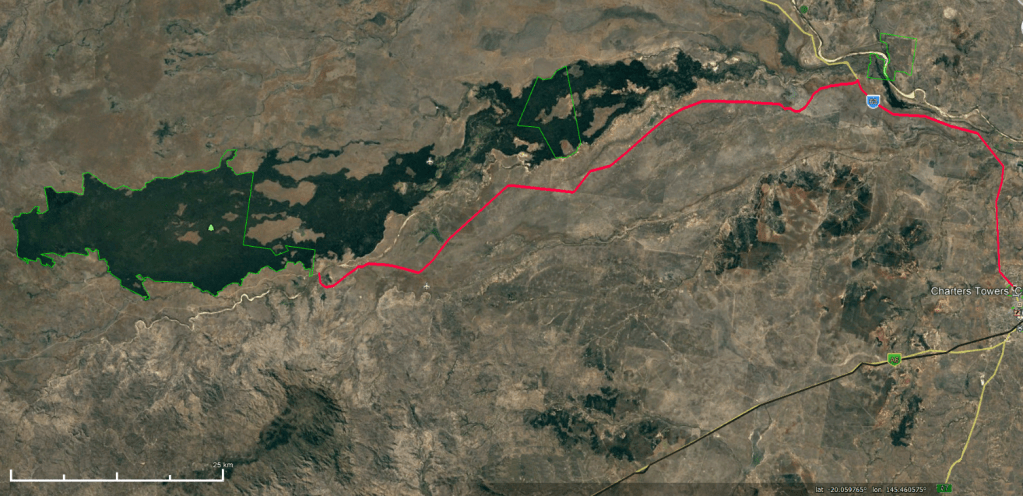
- DERM 2011 Dalrymple National Park Management Plan ISSN 1037-4698
- Mishra AK, Placzek C, Wurster C, Whitehead PW 2019 New radiocarbon age constraints for the 120 km-long Toomba flow, north Queensland, Australia. Australian Journal of Earth Sciences 66: 71-79, DOI: 10.1080/08120099.2019.1523227.
- Stephenson PJ, Burch-Johnston AT, Stanton D, Whitehead PW 1998 Three long lava flows in north Queensland. Journal of Geophysical Research 103 B11: 27,359-27,370.
- Stephenson PJ, Griffin TJ, Sutherland FL 1980 Cainozoic volcanism in northeastern Australia. In The Geology and Geophysics of Northeastern Australia (eds. Henderson RA, Stephenson PJ), pp. 349-374, Geological Society of Australia, Queensland Division, Brisbane.
- Whitehead PW, Stephenson PJ 1998 Lava rise ridges of the Toomba basalt flow, north Queensland, Australia, Journal of Geophysical Research 103 B11: 27,371–27,382.
Great Basalt Wall National Park Project 1: clearing rubber-vine (Cryptostegia grandiflora)
A great field-trip undertaken between June 21st – 25th, 2021, with Queensland Parks and Wildlife Service staff, Lea Ezzy, Sarah Jess, Jason Bruce and Peter Lestone. We camped on Myola Station by Lolworth Creek and were dropped daily into the park by helicopter. Our job was to kill a noxious weed, rubber-vine (Cryptostegia grandiflora, fam. Apocynaceae), in two pockets to retard it moving onto the basalt wall. We did what we could in a pretty tough environment – good that it was winter and fairly cloudy! An interesting observation is that cherry tomatoes appear to be a widespread weed on the basalt areas we traversed.

Dwyer Aviation Services Bell 206B3 JetRanger 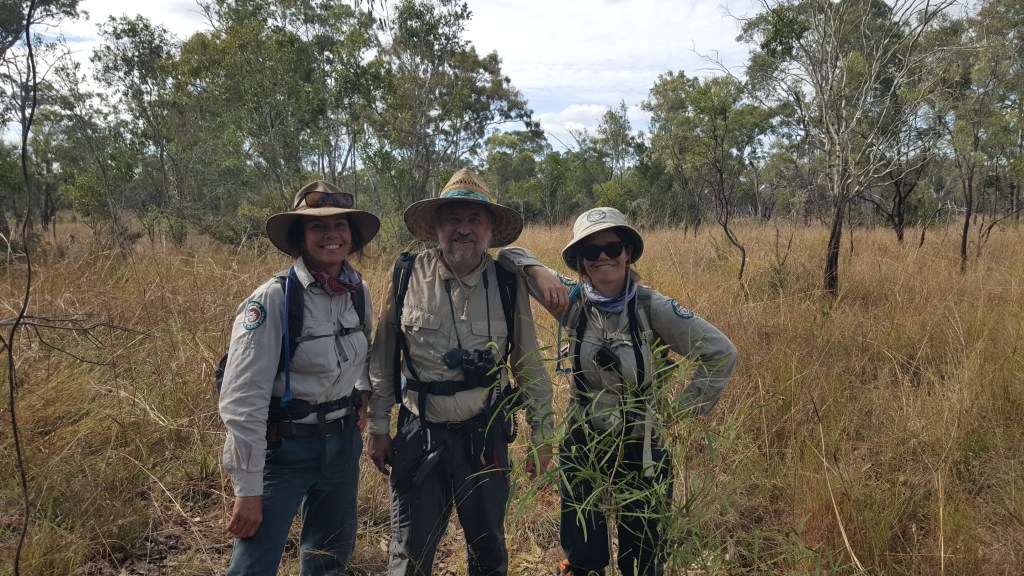
From left: Sarah Jess, Joe Holtum and Lea Ezzy in Pocket 15, Great Basalt Wall National Park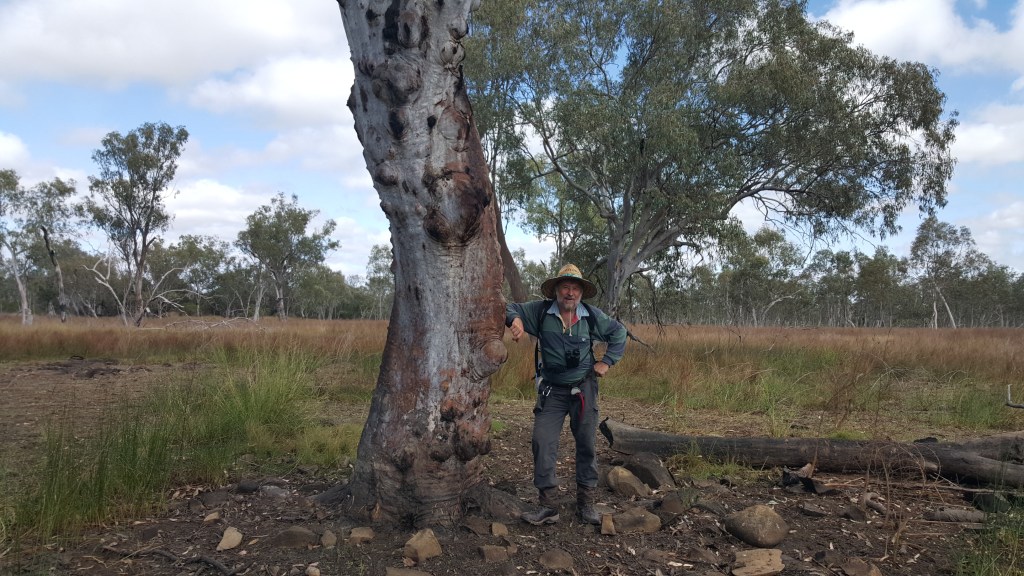
River red-gum (Eucalyptus camaldulensis) supporting Joe Holtum in Pocket 15, Great Basalt Wall National Park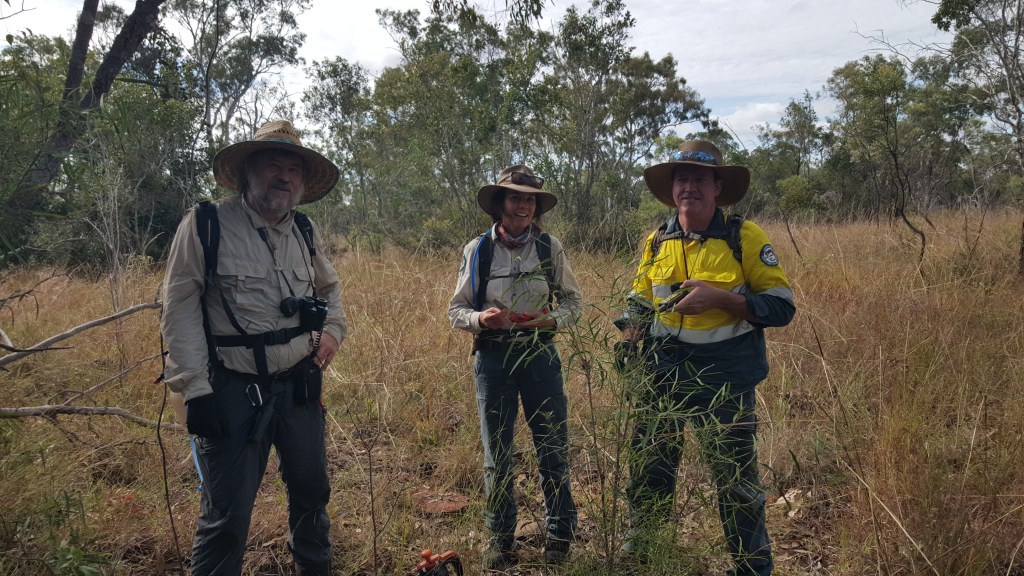
From left: Joe Holtum, Sarah Jess and Peter Lestone in Pocket 15, Great Basalt Wall National Park
Great Basalt Wall National Park Project 2: a study of water-use strategies of four tree species on the wall
The study was the PhD project of Brendan Choat, now at University of Western Sydney (https://choatlab.net/). His results were published:
- Choat B, Ball MC, Luly JG, Holtum JAM 2003 Pit membrane porosity and water stress-induced cavitation in four co-existing dry rainforest tree species. Plant Physiology 131: 41-48
- Choat B, Ball MC, Luly JG, Holtum JAM 2005 Hydraulic architecture of deciduous and evergreen dry rainforest tree species from north-eastern Australia. Trees – Structure and Function 19: 305–311
- Choat B, Ball MC, Luly JG, Donnelly C, Holtum JAM 2006 Seasonal patterns of leaf gas exchange and water relations in dry rainforest trees of contrasting leaf phenology. Tree Physiology 26: 657-664
 Joe Holtum's Science Site